
Maintenance Run-ups
Aircraft engines require regular maintenance to meet the rigors of operational service. To maintain a high level of safety, Transport Canada outlines stringent maintenance standards and requires operators to test engines and their components before the aircraft is put back into service. These tests are referred to as maintenance run-up.
Maintenance Run-ups at YVR
With many operators maintaining their aircraft at YVR, several maintenance run-ups occur daily. Some run-ups are performed during the night-time hours as maintenance is typically done when aircraft return to the airport at the end of the day, and the aircraft needs to be put back into service the next day for early morning flights.
While the duration and engine power setting of each run-up will depend on the systems being checked, maintenance staff will try to keep the duration short to minimize fuel burn and wear on engine components.
Managing Noise from Run-ups
To ensure safety and reduce community noise exposure, maintenance run-ups are tightly controlled at YVR through Run-up Directive and Procedures as below:
- Operators must contact YVR Airport Operations to request approval for a maintenance run-up.
- If approved, the operator is assigned a specific location and heading for the run-up to ensure run-up is performed safely and to help minimize noise disturbance to those living in the immediate vicinity of the airport.
- During night-time hours, the number of approved run-up locations is further reduced to have aircraft positioned away from populated areas as much as possible.
Ground Run-up Enclosure
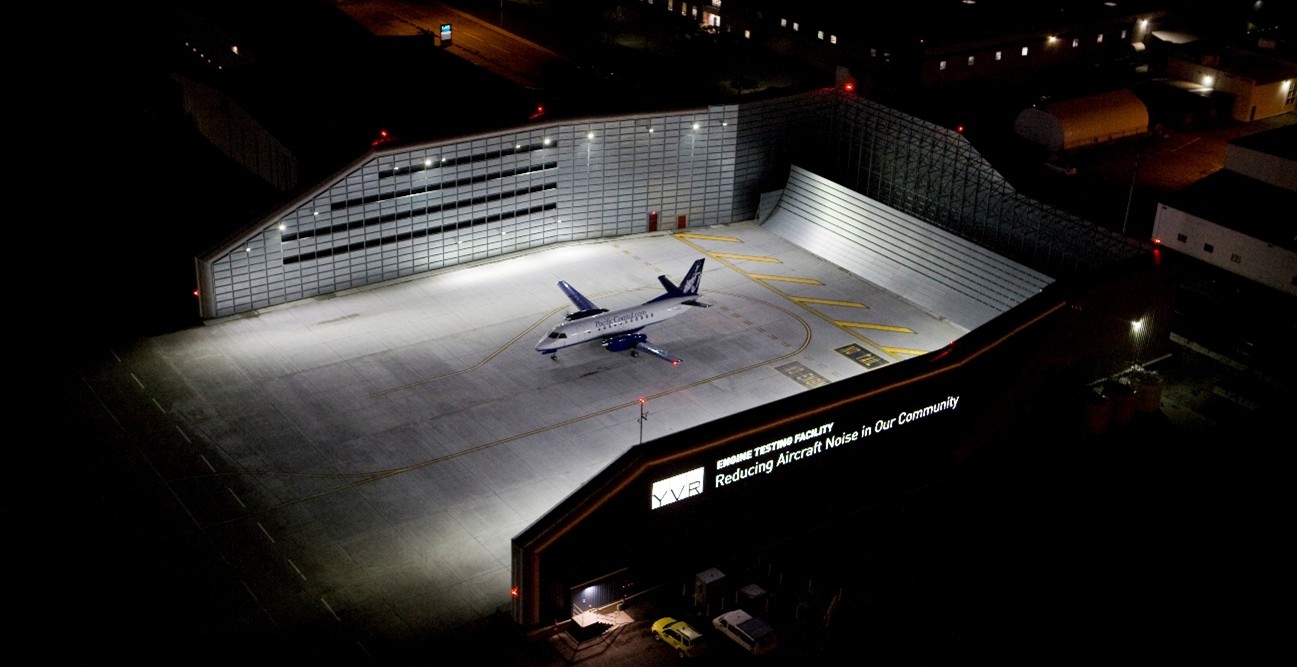
To further reduce run-up noise on the community, YVR built Canada’s first Ground Run-up Enclosure (GRE) in 2012 – a three-sided open roof facility designed to absorb and redirect noise from run-ups inside the facility.
Located near the South Terminal Building, its site was chosen given its proximity to many of the maintenance bases at YVR and the best noise reduction achieved among all sites evaluated. The size of the facility was determined based on the most common aircraft types maintained at YVR. While it can accommodate aircraft size up to a Boeing 757, the primary users are smaller twin propeller commuter aircraft such as Saab 340 and Beechcraft 1900.
The walls of the GRE are made of steel and are lined with approximately 2,000 sound absorptive panels. These panels help reduce run-up noise by 10-15 decibels compared to a run-up on an open apron.Because of this, the GRE is designated as the main location for high power run-ups on conducted on the south side of the airport.
Run-up Noise in the Community
Despite efforts to mitigate noise exposure from maintenance run-ups to the community, noise from these operations may still be audible in the community given the proximity of residential developments to the airport and the complex sound characteristics from the noise source.
If you are disturbed by a run-up, you may call (604) 207-7097 and speak to a representative of YVR Airport Operations. With the information you provide, YVR Airport Operations may be able to dispatch staff to investigate activities on the airfield.
Do You Have Further Questions About Maintenance Run-Ups at YVR?
Maintenance run-up trends and statistics at YVR are available on our Annual Noise Management Report.
If you have any additional questions, please contact the YVR Noise Management Office.
- same as before