
Aircraft Noise Standards and Trends
Over the past few decades, the aviation industry has made significant strides in developing quieter aircraft, thanks to advances in engine technology and airframe designs. Modern jet aircraft are about 75% quieter than the earliest models, and new aircraft entering service today typically have a noise footprint that is 30–50% smaller than the aircraft they replace.
International Standards for Aircraft Noise
Aircraft noise and emissions standards are set by the International Civil Aviation Organization (ICAO), a specialized United Nations agency, which sets standards and regulations necessary for aviation safety, security, efficiency and regularity, and environmental protection. These standards are prescribed in its document Annex 16 – Environmental Protection and serve to ensure the latest available noise reduction technology is incorporated into aircraft design.
Trends in Aircraft Noise
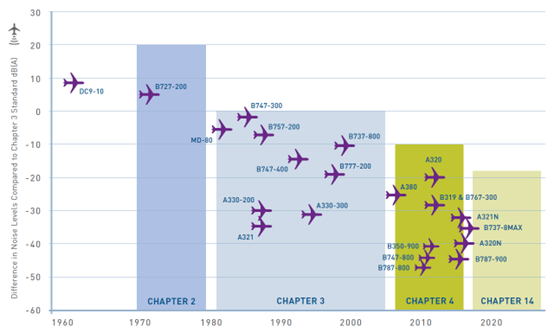
The first noise certification standard for jet aircraft, known as Chapter 2, was adopted in 1971. Since then, ICAO has progressively introduced new standards to reflect technological improvements.
Today, there are four chapters published for jet aircraft: Chapters 2, 3, 4, and 14. Each higher chapter signifies newer and more stringent standards than the previous chapter. In other words, the higher the Chapter number, the quieter the aircraft for its given operating weight as illustrated below:
Aircraft Noise Requirements - Canada
As an ICAO member state, Canada adopts the aircraft noise and emissions standards set by ICAO, which are inserted into the Canadian Aviation Regulations, and Transport Canada ensures compliance through their aircraft certification process.
To reduce noise in communities, Transport Canada phased out older, noisier Chapter 2 jet aircraft over 34,000 kg in 2002. Therefore, all jet aircraft over 34,000 kg currently operating in Canada must meet at least Chapter 3 standards unless an exemption has been granted by Transport Canada. If the aircraft meets the noise standards prescribed by Transport Canada, it is permitted to operate in Canada, and its noise levels are deemed acceptable.
YVR Jet Fleet Mix by Noise Certification
Over 90% of the jet aircraft serving YVR meet Chapter 4 or 14 certification requirements. Additionally, airlines worldwide continue to invest billions of dollars to upgrade their fleet as newer aircraft provide improved noise and emissions benefit.
For further information on YVR jet aircraft mix by noise certification, please see our Annual Noise Management Report
Aircraft Noise Monitoring at YVR
To better understand the contribution of aircraft noise in the community, YVR maintains a network of Nosie Monitoring Terminals across Metro Vancouver. The collected data is used to identify trends over time and share information with the public, but not for enforcement or initiating changes to flight paths.
As noted above, all jet aircraft operating in Canada meet at least Chapter 3 noise standards. In addition, flight paths are designed to meet national and international standards to ensure a high level of safety in the airspace.
For more information on our noise monitoring program, view the Noise Monitoring and Flight Tracking page. Information on noise monitoring data can be found in our annual noise management report.
Questions?
Please contact the YVR Noise Management office.